Back
Local SEO
Google Maps vs. Google Search vs. AI Search: Where Local Businesses Win Customers
Customers find local businesses in three places. Here's what each one looks at, and the work that counts in all three.
4 min read
Three front doors, one customer
Picture a homeowner whose furnace quits on a cold night. They might type "furnace repair near me" into Google and scan the map. They might search "why is my furnace blowing cold air" and read an article first. Or they might ask an AI assistant which companies nearby do same-day repairs. Same customer, same problem, three different front doors.
Each door works a little differently. The good news for a busy owner is that the work behind them overlaps far more than it differs. A business that's easy to understand, easy to check and clearly active gives all three something to work with.
Google Maps: the short list
Search for a service near you and Google shows a map with a short list of businesses, drawn from Google Business Profiles. Google says local results are based mainly on three things: relevance, distance and prominence. Relevance is how well your profile matches the search. Distance is how far you are from the person searching. Prominence is how well known your business is, which Google says draws on things like your reviews and how many websites link to you.
You can't move your shop closer to every customer, so the work goes into the other two. A complete, accurate profile with the right category, services and service area helps Google match you to the right searches. A steady flow of reviews builds prominence, and thoughtful replies show the people reading them how you treat customers. Google is also plain that there's no way to request or pay for a better local ranking, so be wary of anyone who says otherwise.
Google Search: the answers around the map
Around the map sit the regular search results, and that's where your website competes. People don't only search "plumber near me." They search the questions that come before a call: what a noise means, whether a repair is worth it, what a job usually involves. A page that answers one of those questions clearly, for your area, is something Google can show them.
Google's advice to site owners starts with helpful, reliable content written for people. For a local business, that means a page for each service you offer and each town you serve, written the way customers describe the problem. Your Business Profile links to your site, so the two work together.
AI search: the conversation
AI answers now show up in two places. Inside Google, AI Overviews and AI Mode summarize an answer and link to supporting pages. Outside Google, assistants like ChatGPT can search the web and name businesses in a conversation. Google says its AI features rest on the same SEO fundamentals as the rest of Search: to be eligible as a supporting link, a page needs to be indexed and eligible to show a snippet, with no extra technical requirements. Eligible isn't the same as shown. Its checklist even includes keeping your Business Profile information up to date.
ChatGPT's help pages say it can search the web, use a person's general location to find local results, and cite the sources it used. So what an assistant can say about you depends on what it can find and read: your website, your profile, your reviews. Clear, specific pages give it something accurate to work with. Nobody can make an assistant recommend a particular business, and anyone promising that is promising something they don't control.
The work that counts in all three
Line the three up and the same short list keeps appearing. A complete, verified Google Business Profile with the right category and service area. Every review answered. Fresh photos and posts that show you're open and busy. Website pages for each service and town, written in plain language. The same name, address, phone number and hours everywhere they appear.
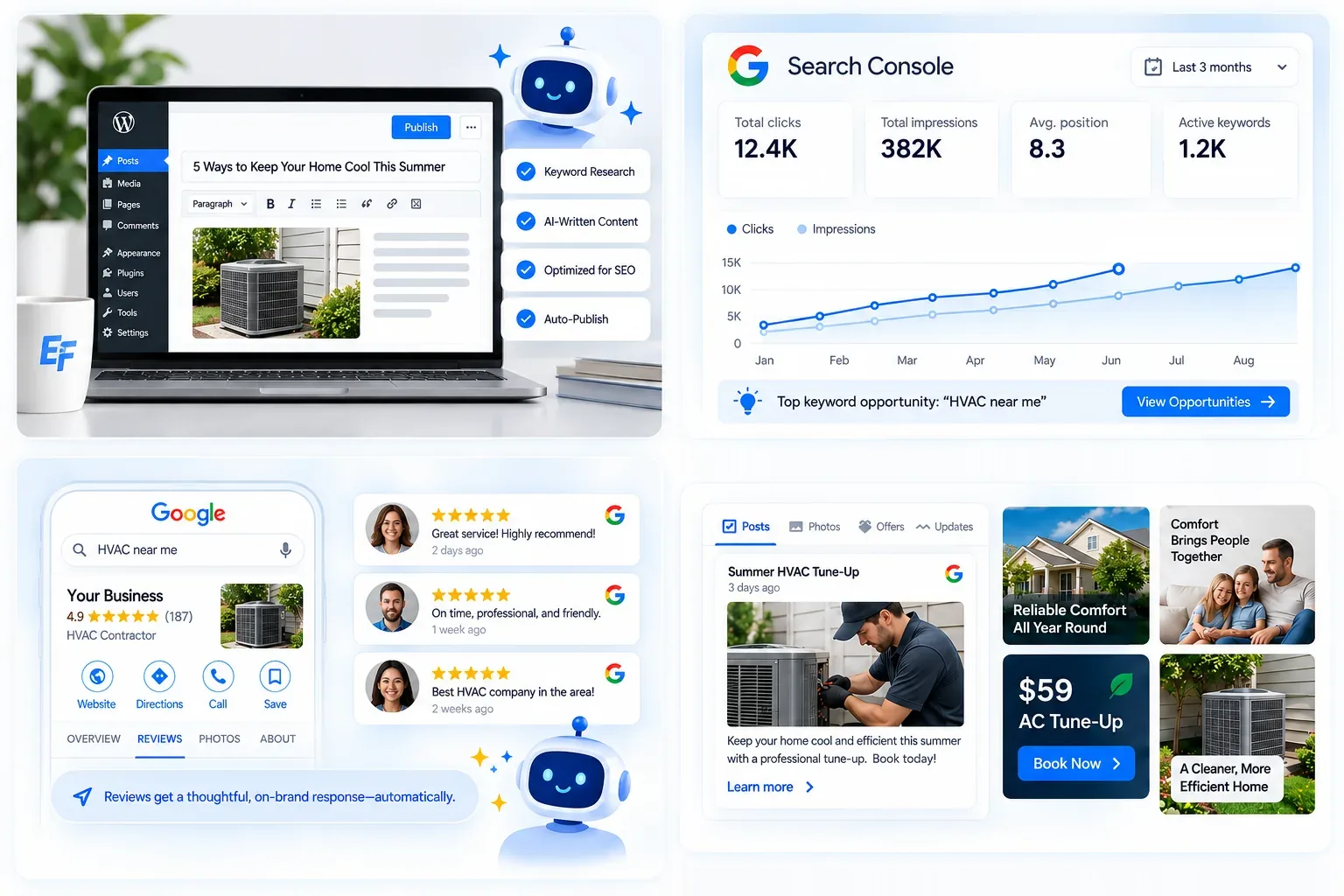
That's the idea behind the Everfound Visibility System: one system working across Google Search, Google Maps, your website, your reviews and AI search, continuously. The Google Presence Engine keeps your profile complete and active, and the Reputation Engine replies to every Google review. On the Grow and Dominate plans, the Content Engine also publishes blog posts and local pages to your WordPress site, aimed at searches from your own Search Console data. Your monthly report shows how your Google presence is performing.
More from the blog
Practical guides on local SEO, AI search, and reviews to help your business get found everywhere.